
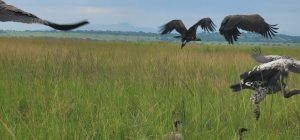
The African white backed vulture and Rüppell’s griffon vulture, taking flight over lush green savannah grassland with distant mountains, one of them is the smallest in Uganda and among the old world vultures the hooded vulture. Its a monogamous bird with exceptional eyesight. They can be found at carcasses or kills in Uganda’s national parks. Ruppell’s griffon vulture at kills can be separated by slightly larger and heavier appearance and for immature ones to gain adult plumage they require 6years.
The foreground shows the intricate, speckled plumage of what appears to be a Rüppell’s griffon vulture with a yellow tip at the bill , while others soar effortlessly above the tall grass. In the background, the rolling green plains stretch out toward a serene range of distant mountains, perfectly capturing the untamed beauty of the wilderness.
Why Vultures Matter to the Ecosystem
While predators like lions and leopards get most of the safari spotlight, vultures are the unsung heroes of the savannah.
-
Natural Cleaners: They safely consume carrion, preventing the spread of harmful diseases to other wildlife.
-
Eco-Indicators: For safari guides and photographers, a circling group of vultures is a natural compass pointing directly to recent predator activity.